Open Source Marketing Checklist

Still, many Open Source projects think they will rule the world without marketing, simply because their software is hyper-fantastic-mega-great. In the early days of Open Source, that might have worked out, at least within the growing group of aficionados.

Today, there is a growing amount of often competing Open Source products and most importantly, the companies or organizations behind the software want to sell to end users who are sometimes not geeks (to say the least).

Hence, it is time to spread the word about your great Open Source product in a way that your focus group(s) understand(s) – and that’s what marketing is about. Some people call it “evangelism”, because the term “marketing” seems to have a bitter taste in the Open Source domain.

Nevertheless, in the end, what you will do, is marketing, and most likely, you will use traditional as well as new fancy means to gain visibility. So, let’s call it what it is.

The main reason why I avoid the term “evangelism” is that Open Source companies are usually technology-driven because they have been founded by software developers. The key for success lies in becoming market-driven and there’s nothing holy about it, it’s rather down-to-earth customer-oriented work.

There is indeed something special about Open Source marketing and that’s the aspect of community relations. It’s got a lot to do with social media marketing and building personal networks, in essence an ecosystem of mutual coaching and support.

I started to compile an Open Source Marketing Checklist in my Wiki and will keep extending it over time. This checklist is supposed to help Open Source companies and organizations to start or sanity-check their marketing. All hints come without any warranty, of course, but they always worked for me.

Lieblinx Seeks Drupal Developers and a Hero

Stefan Kausch, CEO of Lieblinx approached me to help them: They are working on a fancy Web 2.0 site based on Drupal and urgently need one more Drupal developer in their team – starting yesterday. That specific job would last roughly until end of December and can be done remotely.

If you feel like becoming a hero, please write Stefan an email: s (dot) kausch (at) lieblinx (dot) net.

Stefan furthermore told me that they are also looking for Drupal/PHP devs in the long run working in their Berlin office. Hence, feel free to write to him if you are looking for a long-term engagement.

My Home is My Office

Since roughly 5 years I work remotely, from my home office. I did so self-employed as well as employed, being a programmer, consultant, pre-sales, marketing guy and in management positions. I was engaged, now being married, rich and poor, rented a flat and now own a house. Work was pleasant, nerve-wracking, boring, amazing.

Monty and Zak formulated a set of principles and rules for running a Free Software/Open Source business. One rule they proclaim is:

The Employee works in distributed company and may work from anywhere.

In fact, while employed, I was often the only one working remotely from home – quite opposite to Monty’s MySQL, where most people work remotely. Hence, I could clearly see what’s different between me working from home and my colleagues sitting together in an office building.

I realized that it is necessary to visit office(s) regularly, to avoid being cut off from group dynamics and being left without influence. While the company is on track, being there once per month sufficed. The more strategic decisions needed to be made, the more often I showed up on the spot, because nothing beats face-to-face meetings in times of change.

The more people work remotely, the more a company needs to be disciplined and discuss important issues at a given time, either via conf calls or in meetings on the spot, because you cannot easily gather colleagues in one room. It needs discipline to avoid the pitfall of “out of site, out of mind”. A corporate culture not being used to colleagues working remotely quickly “forgets” about colleagues working at home.

The big advantage of working remotely is that you can avoid the traps of group dynamics. To put it bluntly: Put a bunch of people in one room and they will make each other believe what they want to believe. This can end in fatal business decisions. It is good for software companies to have some insiders working from outside, because they can much clearer see what’s going wrong.

Then again, if something goes wrong badly, you cannot change a company’s course from your home office, you’ll need to gather people in face-to-face meetings to build trust, fight for the cause, commit to new goals.

Once, when starting in a new company which was not used to remote work, I had my boss call me several days in a row at 9:00 to see whether I really started work just like the others did. Managers not used to virtual teams, only believe what they see and unfortunately relapse to patriarch surveillance measures of early industrial times instead of trust-based relationships between knowledge workers.

In fact, working at home requires you to be a lot more disciplined and result-oriented and also to be more conscious about your work rhythm and that of your colleagues. At home, you cannot trick your boss into believing that you work simply by staring into a computer monitor.

Goodbye Mindquarry! What Will Be Next?

Although I feel sad that Mindquarry did not work out the way it was meant to be, I am also excited about some great opportunities which came up lately.

First of all, I’d like to thank all my former colleagues at Mindquarry who proved once more that they are real sports especially during the rough times that lay behind us. You can tell their commitment and proudness from the fact that they kept working on the now available Mindquarry 1.2beta release until the last day of the company’s existence.

I very much welcome that the three Mindquarry founders now help Day Software to add collaborative tools to their Enterprise Content Management System. This is an extremely smart move by Day, because each one of the founders are superb developers with an entrepreneurial attitude. Plus, the founders already gained a lot of experience and insights in the collaboration market space – something of high value for Day’s business, because it accelerates time-to-market.

So, what will I be doing? In fact, I am yet undecided whether I will enter employment again or start my own business with a very good friend of mine. Either way, I plan to continue working in the domain of Open Source marketing, be it as part of a firm’s management or as a consultant.

Up-to-now, I have four job opportunities, most of them would also be interested in working with me as an external consultant. What do you think would be the best choice?

Marketing for Idiots

I don’t like marketing phrases trying to pull my leg even before I know what the offer is about. Recently, I received an email from my German mobile phone provider, it starts (translated from German):

You have to grab this chance!

… and I stopped reading and immediately deleted the email. Do they think they can talk me into a buying decision with an initial aggressive sentence?

I get the same feeling of being treated like an idiot after reading lots of information hardly finding the price of the offer, nor being able to make a choice. Try out Microsoft SharePoint Web site – how long will it take you to find a price tag? How much longer will it take until you got an idea which of the SharePoint product variants might be the right one for you?

Some products might need more explanation than others, but in the end, all a customer wants to know is: What do I get for which price?

Assuming that higher intelligence leads to higher income/revenue, why are those with a good spending power much too often being treated like idiots by marketing? Customers mature just like markets mature, urging marketing to catch up, make potential customers feel intelligent and acknowledge that they can decide for themselves.

Open Sourcing Your Life

I often skip Dave Pollard’s blog entries, because they are rather long pieces of text. Yet, Dave’s latest posting struck me:

Our traditional education system teaches learned helplessness, and does not teach us how to make a living for ourselves. It perfectly feeds the industrial business-political-economic system, which wants an excess of cheap, frightened, obedient, dependent labour.

That’s basically how I felt at school and (a bit less though) at university. I dropped out of university, because at that point I had learned what I wanted to learn and it did not make any sense to me to invest two more years just to hold a piece of paper in my hands.

In the same blog entry, Dave writes:

Get a bunch of us together, bunches of bunches of us together, to start imagining how this virtuous cycle could work, perhaps using Open Source, telling stories of this Natural Economy as if it already existed.

Right, Open Source is also a way of living, a way of supporting what Dave calls “Natural Economy”. That’s why I only work for Open Source companies. I would die like a flower not getting enough sun and water in a proprietary company – which reminds me of IBM Distinguished Engineer Gunter Dueck, who believes that human beings should be treated like flowers with some of us loving the sunny deserts with little rain and others enjoying the shadows of a rain forest.

Marketing 2.0 and its Resemblance to Open Source

There is this fantastic working paper over at Harvard Business School that sums it all up so well what has been labeled Social Marketing or Marketing 2.0: Digital Interactivity: Unanticipated Consequences for Markets, Marketing, and Consumers.

The authors hit the nail, positioning marketing in a constructivist manner by referring to Web 2.0 phenomena they describe as “consumer collaboration”, “digitally enhanced communication among consumers”, “peer-to-peer interactivity”.

[…] marketing is a cultural producer. Just as an author puts into circulation words that do not become ideas except in the minds and hands of readers who make them over for individual or social purposes, so marketing in this paradigm aspires to be an author in the culture of its customers. For marketing to play this role it needs to be welcomed, not resisted.

I can’t get that idea out of my head that Marketing 2.0 was actually invented years ago by Open Source developers. Their style of communication has lead to transparent and honest information about their products, something that customers of Open Source software highly appreciate.

Additionally, no Open Source company can afford a marketing guy who has no or only little clue of software technologies, because especially when it comes to community relations (which I regard as part of Open Source marketing) one can only convince by expertise.

Hence, I believe that the Open Source style of marketing aka evangelism aka community relations has very much formed the basis of Marketing 2.0 and contributed to the understanding that marketing needs to act more like an ally of customers rather than an intruder (e.g. by aggressive mass advertising).

This makes me hope that with Marketing 2.0, things will become more realistic in all kinds of businesses. Marketing staff will loose their nimbus of spin doctors, magical seducers and manipulators. Instead, marketing will be much more about forming trustworthy relationships based on human interaction between a company and its customers.

Marketing 2.0 also requires marketing persons as well as management and staff in general to develop their own voice, because only authentic communication e.g. via blogs can leverage “the power to mobilize identity” (as the working paper states) within and between customers and company.

Something I miss in the HBS working paper is a discussion of Long Tail effects on marketing. For example, whether and how social marketing needs to be different in the head and the tail?

Vacation at Lago Maggiore, Italy

Just back from a 1 week vacation at Lago Maggiore, Italy with my wife.

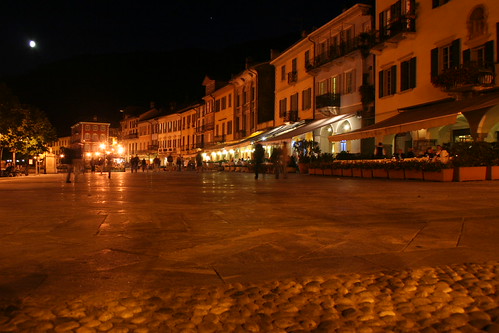
We stayed in a holiday house in Traffiume, a tiny and lovely village close to Cannobio. We realized after some sight seeing around the lake, that Cannobio was actually the nicest place at Lago Maggiore. It has a rather large historic center, a beautiful promenade at the lake, great restaurants, fantastic ice cream – well, simply, everything you expect from a gorgeous and relaxed Italian town.
IMG 5106
IMG 5103
Of course, we did visit the Borromean Islands, but only Isola Bella and Isola dei Pescatori. Though there were tons of tourists on Isola Bella, we could still enjoy the fantastic scenery – this island is a must-see! Make sure you visit the palazzo, it’s worth the high entry fee.
Palazzo of Isola Bella
We also made a trip to a little medieval village up in the mountains, called Gurro. Driving the curly and steep road was itself an interesting experience.
IMG 5091
On our way back home, we stopped by at Locarno and enjoyed a few ruminant moments in the backyard of the citadella.
IMG 5131
See all pictures from our trip to Lago Maggiore in my Flickr photo set.