
Improve Your Open Source Sales Funnel with Targeted Marketing Collateral

One of the great things about Open Source software, is its ability to significantly cut the length and expense of the sales process, by allowing prospects to “self-qualify” themselves for the product offering. Simply put, because an Open Source software product is freely available for download, potential users can get it, try it out, and decide for themselves whether it works for them. If it does, they can then decide to approach the vendor for additional services or technical support.

From the Open Source vendor’s perspective, this is a great place to be, because it’s getting a constant stream of leads which are (a) already educated about the product and (b) interested in pursuing a commercial relationship. This makes things much easier for the vendor’s sales people, because they typically need to do far less work in convincing the prospect of the suitability of the product and they can instead focus on meeting specific requirements and closing the deal. In summary, a shorter sales cycle for the vendor and clearer expectations/less disappointment for the customer.

Understand the Buying Process (and the Buyer)

The trick to this, of course, is to ensure that prospects have enough information to self-qualify. And this is not simply a matter of “provide a download link and they will do the rest”. For an Open Source vendor to fully exploit the informational advantages of Open Source, it needs to make sure that potential customers have all the information they need to satisfy their questions and concerns independently. And so, it is necessary to prepare and make available different types of marketing collateral for each stage of the buyer decision process.

There are two important aspects to consider here.

1. The stage of the buying process

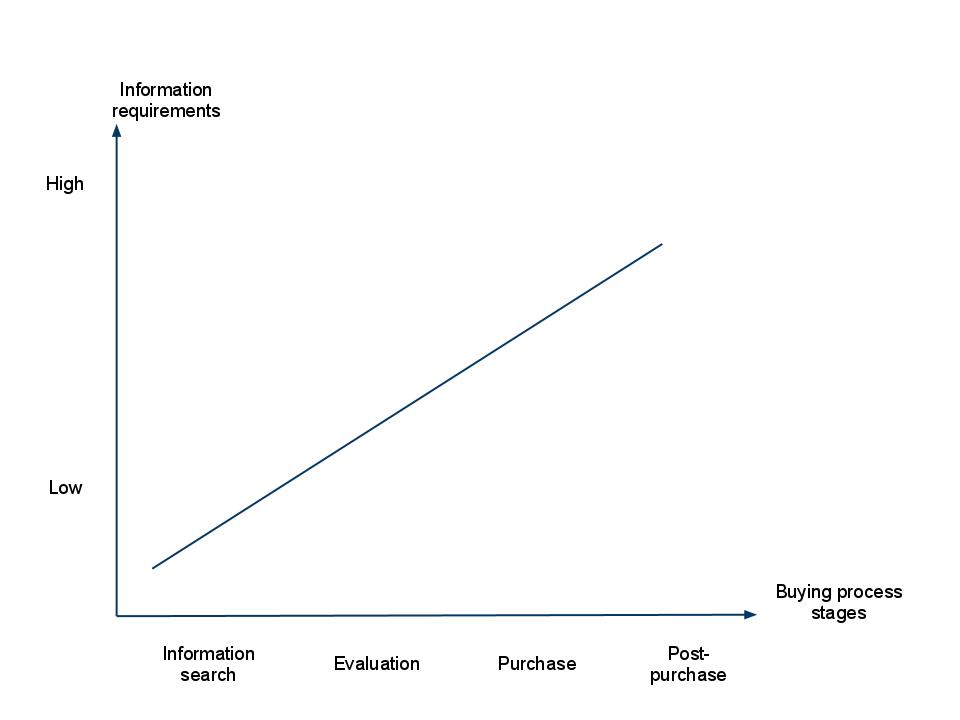
The typical buying process consists of need identification, research, evaluation of alternatives, purchase and post-purchase evaluation. These stages are performed sequentially, and the prospect’s information requirements change from one stage to another.

For example, in the first and second phases, the prospect may have a wide range of options, but as the evaluation progresses, the field is whittled down to a few likely candidates. Correspondingly, the granularity of detail required also increases: for example, in the first two stages, the prospect may only be interested in (say) the platform and integration requirements, but once the main candidates are identified, the prospect will examine each in detail to understand the relative benefits of each. This is clearly seen in the following simple diagram.
2. The status of the buyer

The status of the buyer must also be considered. In small firms, the economic buyer (the one who actually pays for the product) and the decision maker (the one who takes a final purchase decision) might be one and the same. However, in larger organizations, the decision maker might be a developer, while the economic buyer might be a business manager or CFO. The information provided must be correctly targeted to the buyer’s status within the organization.

For example, consider the evaluation stage. At this point, a developer is keenly interested in the technical benefits of the product and so would gain maximum value from technical white papers, sample code, technical presentations, and other collateral that illustrate the technical capabilities of the product. However, a business manager at the same stage of the process would like to read case studies of similar deployments, white papers about collaboration features, data sheets listing service and support options, and so on.

Marketing Collateral Cheat Sheet

Here’s a quick cheat sheet, based on my experience, of what you could provide to different types of prospects to help them at each stage of the buying process:

Information search Evaluation Purchase
Business Manager or CxO Product brochuresBusiness white papers

Third-party reviews

Case studies for similar deployments

Service and support data sheets

Sales presentations 

Demos

Project Manager Product brochures 

Business white papers

Third-party reviews

Case studies for similar deployments 

Service and support data sheets

Competitor analysis

Sales presentations 

Demos

End-user or Developer Technical feature overview 

Technical white papers

Third-party reviews

Technical manuals or API documents 

Demos

Screencasts and videos

User manual

Demos

A final question to consider: how do you actually make all this material available to prospects? The best way is through your Web site, as this offers several advantages:

  • It’s the first place a prospect will visit for more information on your product/service offering.
  • It’s publicly accessible, which means that sales people (yours and your partners’) can use the same collateral for direct sales.
  • It’s central and 100% under your control, which ensures that updates occur in a single place and you don’t have to worry about salespeople or partners working off outdated material.

Conclusion

Open Source offers a number of advantages, and these are not restricted only to the software aspects of your product or service. By making available as much information as possible, you’re allowing potential customers to validate your offering against their needs, and giving them the tools to make an informed decision. This allows them to self-qualify or self-disqualify themselves, serving as an automatic filter and granting you the benefits of a shorter and more effective sales cycle.

Brands Develop Over Time

All too often, companies think of branding as a one-time effort: they define the market positioning, create a brand and logo to reflect this positioning, and then take this brand into the world. All marketing activities that follow from this – advertising, public relations, promotions, customer communication – are based upon the defined brand identity. The truth is that brands develop over time and while they mature, the messaging needs to be revised.

Brands Reflect Perceptions (and Vice-Versa)

A brand is special, because it is an identity constructed in our minds and it creates an emotional as well psychological connection between the company and its customers. Each customer is likely to interpret the same brand in a subtly different manner. Thus, a brand isn’t a “one size fits all” representation of a company; rather, it is the composite of multiple individual perceptions and emotions. As Daryl Travis, in his book Emotional Marketing, notes “…a brand isn’t a brand to you until it develops an emotional connection with you.”

What many companies forget is that a brand is a living entity. Just as a brand shapes customers perceptions, it too is shaped by perceptions – both of its customers and of its staff. And as a company learns more about itself over time, as it begins to look at itself from different perspectives, its brand too must evolve and reflect this additional knowledge and intelligence.

A Few Examples

If you take a look at some software brands, you’ll clearly see this evolutionary process taking place. Here are some examples:

  • Apple‘s original logo (pre-1976) depicted Sir Isaac Newton under an apple tree. However, this was soon replaced with the famous “bitten apple” silhouette, which had cleaner lines…perhaps intended to highlight’s Apple’s clean, smooth designs. Initially filled with rainbow colors, the logo has evolved into a monochrome design – first black and then the current transparent/glass version. In short, as Apple’s unique design culture has emerged and as customers have also begun to recognize (and expect) cutting-edge design from Apple, the brand has evolved to match and reflect these expectations.
  • Another interesting example is SugarCRM which, back in 2004, had a tagline describing it as “commercial open source customer relationship management”. However, as time has passed and the CRM category has become well established, the company has dropped this explanatory tagline from its brand identity. The cube-shaped logo is a relatively recent addition, and perhaps is intended to represent how its product brings together different facets of information to create profiles of customer relationships.

The Evolution of Identity

A brand’s identity typically goes through the following phases, which usually manifest in the taglines you find in Website headers or advertising slogans:

  1. A young brand needs to be explained, thus a category-style tagline is chosen (just like SugarCRM did in its early days, see above).
  2. The brand has established itself in its category, the company has a strong identity and changes its tagline to an emotional one (think Apple’s “Think Different” slogan).
  3. The brand is the leader in its category and has a high visibility, the tagline is abandoned because the brand now speaks for itself (Apple or Amazon.com nowadays).

An analogy would be to compare brands with human beings. For example, when introducing yourself, you tell the other person your name, why you are there and perhaps what you do – just like in the first phase of a young brand. The better someone knows you, the more they will be able to decide how they want to relate to you and whether to enter a (private/business) relationship. The deeper the relationship, the more important emotions become. Once you and a related group know someone really well, you won’t have to explain to the group who e.g. “Marc” is, because they know him, thus the personal brand speaks for itself.

Given that brands are constructed in our minds, this analogy is actually quite powerful, because we are social beings and the way our mind works when it relates to something is greatly influenced by how we build relationships with other human beings.

Conclusion

What does this mean for you, the Open Source vendor? Simply this: as your product and your market evolves, you need to occasionally step back to refine and focus your brand strategy. In most cases, any changes you end up making to your brand strategy will be evolutionary rather than revolutionary, reflecting the changes in knowledge and perception that have accrued to the company over the preceding period. Doing this every two to three years will help ensure that your brand is relevant and in tune with the needs, expectations and perceptions of your customers and yourself. Essentially, your brand will go through different phases of its identity, just like a human being does as it grows older.

Why Your Open Source Firm Needs a Marketing Strategy

One of the questions I commonly hear from clients is, “Why do we need a marketing strategy? We already have [a PR agency/a Google Adwords campaign/a Facebook presence] that’s working for us, so what’s the point in spending time and money on this?”

In this blog post, I’d like to shed some light on this topic, listing some key reasons why every firm, especially (but not only) if it has an Open Source product, should take pains to create a marketing strategy for its offering. In my experience, this is one of the most critical activities a firm should undertake, and it invariably pays dividends over the long run.

After all, the most valuable asset of Open Source is open conversations that bring together users/buyers and vendors. Your firm should speak with a consistent voice to establish a strong and credible brand.

Understand Where You Are

To be successful in any business, a firm needs actionable, accurate intelligence about the marketplace. The typical marketing strategy will perform a thorough analysis of the firm’s current internal and external environment, thereby giving the firm an accurate snapshot of the status quo and key market trends. Strategic tools like SWOT analysis, market segmentation, and competitor arrays ensure that the firm has a good idea of where it stands vis-à-vis competitors, and offer some ideas about its unique strengths and advantages.

For firms that are creating a marketing strategy for the first time, this information is typically a major eye-opener. For example, the analytical output of the strategy document may help them realize that they’re competing against the wrong firms, or trying to attract the wrong type of users for their product. Performing this analysis may also throw up opportunities they hadn’t been aware of in the past.

Create Consistent Behavior

If a firm has a medium- to large-size marketing department and/or if it works with multiple outsourced agencies, a marketing strategy ensures consistent behavior across members, departments and third-party agencies. A marketing strategy clearly identifies the positioning of the firm and, by extension, its key competitors and target segments. This information keeps different arms of the same organization on the same page, ensuring that all work together on a common goal and mission.

So, for example, if the strategy identifies developers as a key segment, salespeople will know they need a technical sales script, PR agencies will know they need to pitch articles to developer journals, and copy writers will know that Website copy should identify developer benefits. Similarly, partners know which clients are best suited to the firm’s solutions, and will not recommend it to prospects who don’t match the profile.

Optimize the Marketing Mix

A marketing strategy will also help a firm optimize its marketing mix. Every marketing strategy will examine the classic “Four Ps” of marketing along with some additional Ps that are especially important in Open Source community marketing (participation, peer-to-peer, personalization, …), and this examination, coupled with the market analysis and trends, will help the firm better understand what it is marketing, and how it is doing so. For example, based on the SWOT analysis, a firm might refine its existing product/service offering (eg. a product specifically for PHP developers) to better play to its strengths, or it might review existing trends and thereby determine new delivery methods (eg. SaaS) that it can utilize to reduce its distribution cost and extend its reach.

Monitor Progress and Build Business Intelligence

Creating a marketing strategy is, in essence, a process of “writing things down”. The strategy developer is creating a journal or log of data, drawing conclusions from it, and then making operational recommendations. At the same time, he or she is also recording the results of previous recommendations. There are two key outcomes from this:

  • The strategy document works as a measurable checklist, allowing the marketing team to have a written record of planned high-level actions and thereby measure marketing progress and success. By listing and prioritizing marketing activities, it works as an action plan for the marketing manager or marketing department, helping them to organize marketing activities in an organized, systematic manner and with sound rationales and goals for each activity.
  • It serves as a “living document” of what worked, and what didn’t, thereby avoiding costly mistakes in the future. So, for example, if the strategy recommended attending a particular trade fair, but real-world analysis after the event showed a negative cost/benefit ratio, it serves as a flag to tell the marketer to consider dropping the event in the following year. As such, this written record adds to the collective knowledge of the firm and helps it learn from its mistakes.

Conclusion

It might be self-evident that as an Open Source marketing consultant, I would advise any Open Source organization to build and implement a marketing strategy (after all, this is how I earn my money). However, the fact remains that in my experience, this is never a wasted effort and the long-term benefits are significant, both in keeping the firm on track to meet its long-term goals and in giving the top management a tool or framework to define the evolution of the product.

Open Core or Solutions: Choosing the Right Open Source Product Architecture

Today, more and more proprietary software vendors are choosing to go Open Source. Doing this enables them to leverage the community benefits of Open Source, shorten the sales cycle, and gain a competitive advantage over other proprietary products.

However, for those firms considering a switch to Open Source, there are some hard decisions to make with regard to their product architecture. Should they provide only a single Open Source product, and earn revenue from add-on services like support and consulting (RedHat)? Or should they adopt the Open Core model, offering their product under both Open Source and proprietary licenses (MySQL)? Or perhaps some hybrid of these two approaches?

In this post, I’ll consider two common architectures, which I’ll respectively call the “Open Core” and “Solutions” architectures.

Open Core Architecture

The term Open Core is used to describe business models where vendors offer both an Open Source “community edition” and a more fully featured, commercially licensed “enterprise edition”. MySQL is undoubtedly the most common example of this model, although it’s widely in use among other firms as well.

Typically, the enterprise edition product comes with vendor guarantees and support, thereby making it more attractive to larger enterprises. At the same time, it ensures that smaller firms and individuals, who may not require these attributes, are not excluded, as they can freely access and use the community edition of the product, albeit without any guarantees.

Solutions Architecture

Under the Solutions Architecture, a vendor offers separate packages or distributions of the same Open Source product, identified in terms of the functionality they add. Thus, rather than an “enterprise edition” and a “community edition”, the vendor might provide specialized offerings for different skill sets such as a “developer edition”, “database administrator edition”, “project manager edition”, and so on.

Typically, each solution comes with vendor guarantees and all the distributions are based on the same Open Source code base. This ensures interoperability and peace of mind. At the same time, this approach is economical for end-users, as they only pay for the product features that they need, and so it allows both individuals and large enterprises to participate in the product ecosystem.

Which is Better?

Given these two options, which should a firm choose? Here are some arguments to consider:

  • Under the “Open Core” architecture, the vendor’s community edition may be perceived as “crippleware” lacking the more advanced features found in the enterprise edition. Users may accuse it of cynically providing a functionally limited Open Source version merely to drive sales of its commercial version. This can lead to a negative impression of the vendor, and may adversely affect its market positioning.
  • At the same time, by using Open Core terminology such as “community edition” and “professional edition”, the vendor might be seen as implicitly categorizing some users as “non-professional”. Where these users are also contributing to the community, this will naturally cause friction and conflict. The Solutions Architecture, by contrast, makes no such claims and is less likely to produce an “us versus them” mindset.
  • In a fragmented, highly competitive market, a vendor faces competition from multiple niche products, both proprietary and Open Source. In this situation, the Solutions approach allows the vendor to compete effectively against these specialist products, as each distribution is narrowly positioned to attract a distinct market segment.
  • On the other hand, the Open Core approach is an easy sell to the enterprise market. The typical enterprise edition product will include technical support, warranties, SLAs and compatibility guarantees, all of which are critical to medium- and large-size enterprises. In general, it is also easier for a direct sales force to sell a single enterprise-focused product rather than a distribution-based product line.
  • The Open Core model is already successfully in use by many firms. It therefore has the benefit of pre-existing market awareness and acceptance, and it is easy for customers to understand its nomenclature and business benefits. This simplifies the sales process, as there is less customer and salesperson education required.

Conclusion

As the above arguments make clear, there aren’t any hard and fast rules about which product architecture is “the best”. However, it’s possible to identify arguments for and against each approach, and thereby decide which one will be best suited to the firm’s specific goals and requirements. Needless to say, the final decision will have a far-reaching impact on the firm’s business model, competitive positioning and marketing strategy…and so, it should be taken after due consideration of all the relevant factors.

Distribution Model for Vendors of Open Source Software

For a firm with an Open Source product, making the software available for no cost is a great way to build a community around it and foster bottom-up adoption. However, this is just the beginning: the firm still faces the challenge of monetizing the product, converting intangible assets such as “Open Source freedom” and “community goodwill” into real money that can be used to fund further product development and community building activities.

In a previous blog post, I discussed one possible strategy for monetization: a modules marketplace for open source products. However, this isn’t the only approach. At Initmarketing, we developed a distribution model to help identify distribution channels for commercial open source that add value and provide a way to put a price tag on elements of the commercial offerings (products, modules, and services).

Understanding The Model

This model explores three facets of distribution: product/service offering, delivery method and distribution channel:

  • The Offering column lists the firm’s available market offerings. These could be different flavors of its product(s), product plug-ins and extensions, and related services such as consulting, training or technical support.
  • The Delivery Method column lists all the available delivery methods for the firm’s offerings. For Open Source software, the most common method is usually online delivery, but some products and services (eg. training) may also be delivered directly at the customer’s premises. Many firms also choose to make their products available as a Software as a Service (SaaS) offering.
  • The Channel column describes the distribution channels available to the firm. The obvious one here is the firm’s Web site, which is typically the first place a customer will look for the Open Source product. Many firms also enter into relationships with partners (eg: OEMs or system integrators) to achieve higher distribution for their product. Finally, firms can also opt for the direct sales route, as a supplement or alternative to partner relationships.

An Example: Typical Open Core Product

The model described above becomes valuable when you begin to connect the elements in the three columns together in the context of your firm’s business model. To illustrate, consider the case of a typical Open Core product, which is available in two flavors: Community Edition and Enterprise Edition. If you were to model distribution channels for such a product, here is what it might look like:
From the above it should be clear that:

  • The Community Edition is available for direct download from the firm’s Web site. It might also be available in the firm’s online shop (if present) as a free download.
  • The Enterprise Edition is delivered on-premise and as a hosted offering, either directly by the firm or through partners.
  • The firm also offers both commercial and free modules for the product, which are available for direct download from its Web site (free modules) and for purchase through its online shop (commercial modules). Both types of modules can also be delivered on-premise through partners or direct sales.
  • Services such as consulting and technical support are available on-premise through partners and direct sales.

The above diagram represents some of the typical cases for an Open Core licensed product. For other types of business models, the diagram would change accordingly.

Base for Further Analysis

In addition to providing a birds-eye view of the current or proposed distribution strategy, this model also provides a base for further analysis. For example:

  • It provides a way to identify which delivery methods and channels are most utilized, simply by looking at the number of connections, and thereby derive additional information about sales process requirements. For example:
    • Where products, modules and services can all be delivered on-premise, this imposes a requirement on sales staff to have sufficient knowledge and marketing collateral for all these offerings.
    • Where products and modules are available both for free download and purchase via the Web site, the Web site must provide corresponding information and support infrastructure (eg: payment processing, security, account management).
  • It quickly identifies areas of under-utilization, which in turn represent potential opportunities for product distribution. For example, the diagram has no arrows entering or leaving the SaaS delivery method. This might be an opportunity for the firm to develop a new business model, by delivering its product as a SaaS solution for a specific market niche.

Summary

Distribution is key to getting an Open Source product into the hands of users and developers, and monetizing on top of user adoption. This model is a useful tool to add to your Open Source marketing toolkit as it provides a way to identify key distribution channels for different elements of the commercial offering, identify areas of concentration or under-utilization, and find unexploited opportunities.

Session at Open World Forum: Does Open Source Need Marketing?

Open World Forum 2010 In case you’ll attend the Open World Forum in Paris next week, make sure you join me and my team mate Rory MacDonald for our session Does Open Source Need Marketing?.

During this 1h session, we’ll testify some of the common misconceptions of marketing open-source software. We’ll also discuss major trends in marketing communications for open source vendors.

For example, one slide we prepared shares the mantra “It’s not about the code, it’s about conversations, stupid”. Furthermore, we’ll provide some recommendations regarding Marketing 1.0 vs. Marketing 2.0 and how your brand will work for customers and the community alike.

The session is part of a full-day Think Tank on open source marketing entitled “All Change Please”, which features one more workshop presented by Simon Phipps, Carlo Piana, Charles H. Schultz. Patrice Bertrand, CEO of SMILE, will also take part in the Think Tank.

‘Nough said: Learn more about the bleeding edge of open source marketing and join our session October 1st, 14:00-15:00.

BTW: I’ll attend the 2010 Paris Open Source Think Tank as well, which takes place prior to OWF.

Open Source Vendors Must Think Global

Open Source software vendors outside of the U.S. or UK tend to make a fatal strategic mistake: They sacrifice international marketing communications at the altar of a regional sales focus.

For example, an Open Source business started in Spain will naturally feel more comfortable with doing sales in Spain with most employees speaking and thinking in Spanish. Spain is where our sample company comes from, it’s a safe haven, and it’s where the bulk of sales are being made. Why should they go global, invest in building an international business and take the risk?

Sooner or later, there will be global competition in the same niche from another Open Source vendor or project. Someone else will reach a critical mass of international community and business adoption much quicker than the Spanish company will ever be able within its country of origin. And then our sample vendor will find itself against a much stronger competitor who isn’t afraid to take risks.

Essentially, Open Source vendors must think of themselves as global and look at regions as regions, and not the other way round.

In order to do this well, English should be the main language of communication with the public right from the start. Make sure all general marketing collateral is first available in English. This will make English and an international point of view part of the company’s DNA from the beginning, which is critical for success.

Independently, it is of course important to note that in some regions you will only be able to attract early adopters by communicating in English. Pragmatist buyers in countries such as France or Germany will appreciate if your sales stuff spoke French or German and related marketing collateral were available in their native language. This trend of early adopters willing to try out English-only products while mainstream users wait for the product to mature, allows for easy and free market research. If the early adopters in a region start using and talking about your project and you were able to win a few prestigious customers, it is time to consider localizing there.

So, don’t make this mistake, thinking like a regional Open Source vendor that goes global. Rather think like an international company focusing its sales efforts towards certain regions.

Looking at this from another perspective, I never understood discussions whether MySQL (for example) is a European or US company? Trying to link banner Open Source vendors with national or regional pride is totally neglecting the fact that Open Source is and always has been a global business.

Commercialization of PHP Software

I’ve just published an article that explains how a PHP-based product can gain a good position in the market and be made appealing to customers by using marketing communication. The focus is on products licensed under an Open Source license. Yet, most of the recommendations also apply to proprietary offerings.

The article has initially been published in German by PHPmagazin. It has now been translated to English and is available on the Initmarketing website: Commercialization of PHP Software.

Alexander Kempkens Joins Initmarketing

akempkens_96x96I am particularly proud to welcome Alexander Kempkens on board of the Initmarketing team. Starting in 2004 as a developer for the Mambo project he co-founded the Joomla CMS in 2005. Ever since he is working for the Joomla project as community manager and was the responsible of marketing/communications and events coordinator. In addition to that, Alex has recently finished his studies in International Management. Hence, he is one of the very rare people who have combined expertise in marketing, community development, software programming and business management with experience in the Open Source domain.