The Long Tail of Open Source Marketing

Almost done with reading Chris Anderson’s book The Long Tail. Although the book mainly focuses on the CD, DVD, books market, the principles can be applied to Open Source marketing, i.e. marketing an Open Source product. (Read the book anyway, because you’ll learn about fundamental changes in today’s economics!)

Most notably, I like the distinction between traditional media as pre-filters and social media as post-filters:

As such, in Long Tail markets, the role of filter then shifts from gatekeeper to advisor. Rather than predicting taste, post-filters such as Google measure it. […] In general, blogs are shaping up to be a powerful source of influential recommendations.

What we do at Mindquarry, is a mix of both, traditional (pre-filter) and social (post-filter) marketing. Something like a beta release of our software will be pushed via blogs, while a PR about a stable release will be send out to traditional media.

The interesting thing about social media is that a e.g. a blog entry need not come out latest 1 day after the beta release. Because blogs are a lot about the blogger’s individual authority, it’s still worth writing about a beta release even 2 weeks after it has been released.

Post-filters have a longer span of attention compared to pre-filters. This allows you to plan the PR for a stable release in a way that you first finish the work for traditional media (e.g. writing the respective press release) and after the release announcement you have 1 or 2 days to prepare the bloggers pitch or review guide.

There is one important exception to this rule: If you plan to “leak” exclusive information to a blogger or traditional media, you of course provide that info to them in advance of all others.

The Open Source Promise

Panel I attended the panel discussion entitled “The Open Source Promise” at Red Herring Spring 2007 yesterday. Here are the aspects I found most interesting:

Marriage of SaaS and Open Source

Most of the panelists do a mixture of traditional Open Source model (software + services) and Software as a Service (SaaS). Seems like this becomes the mainstream business model for Open Source products that are useful for end users/consumers. At Mindquarry, we’ll offer a hosted solution of our Open Source product as well.

Ranga Rangachari (Groundwork Open Source) sees a general move away from the typical use of self-hosted Open Source software within enterprises towards SaaS.

Bill Soward (Adaptive Planning) described that there’s a successful path for lead generation from those who download and try out the freely available Open Source product and then simply buy a subscription for the SaaS offering to use it in production.

Bob Walters (Untangle) made a highly interesting general comment on the “marriage of Open Source and SaaS”: The central issue here is that e.g. a (the?) major SaaS provider, Google, made several great improvements to the Linux kernel but does not give them back to the community. Here, SaaS works against the community spirit of Open Source. GPL v3 is supposed to help avoid this issue.

Community is your main business

Bob Walters made a good point in saying if you miss attracting a developers community, you miss 75% of your business.

Linux will win the mobile market

Dells recent announcement to ship their computers packaged with Ubuntu lead to the question of Linux on the desktop. Michael Sikorsky (Cambrian House Inc.) stated that Linux will definitely win the mobile market, even if it won’t make it on the desktop.

How to provide support for all Linux distributions

Mike Guiterman (SourceFire, the company behind Snort) made a general comment on what the diversity of available Linux distributions means to his Open Source company: They make sure that their product supports the main distributions and have the community provide solutions and services for all other.

Datamation Lists Mindquarry as Bleeding-Edge Open Source Company

Datamation just published an article entitled Ten Bleeding-Edge Open Source Companies:

Firms that represent the future of open source, from start-ups to established enterprise plays. We look at strategy, funding, and management.

The article also sheds a light on Mindquarry and IMHO, they paint a realistic competitive landscape and identify the main challenges as well as potentials for Mindquarry.

We see a lot of potential in our unique and compelling business model, which can be described as “Web 2.0 meets Open Source”. We (will) offer Mindquarry packaged as

The combination of these is a huge competitive advantage. For example, users of our upcoming SaaS offer can potentially also use Open Source clients for Mindquarry (e.g. to manager their tasks offline) developed by our community (e.g. for their PDA or Mobile Phone).

Freedom of Collaboration

Mark Shuttleworth says:

Iâ??ve long believed thereâ??s a general phenomenon that underlies the free software movement. Itâ??s â??volunteer-driven, internet-powered collaborationâ?.

I’d call it “freedom of collaboration”.

This freedom will eventually spill over from public collaborative environments such as public SVN and CVS repositories or Wikipedia to corporate collaborative workspaces, simply because it results in more efficiency and better results. Freedom of collaboration within and between businesses is at the core of what constitutes the Enterprise 2.0.

The aim of Mindquarry’s Open Source collaborative software is, to allow all sorts of knowledge workers in various types of organizations to work just like Open Source developers or Wikipedia editors in modern teams. We bring them the freedom of collaboration. Yep! 🙂

User-Centered Design

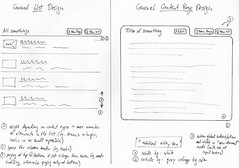
Sketch of Mindquarry 1.1 GUI

My colleagues at Mindquarry have done a great job in planning the new graphical user interface (GUI) of the upcoming version 1.1 of Mindquarry Collaboration Server. Instead of long fights about believes on what users really want, they simply did usability testing.

Mindquarry’s Chief Architect Alexander Klimetschek blogged about the approach and the results. His slides about User-Centered Design (UCD) for Mindquarry provide a good summary.

That made me think about those Open Source projects with Web- or Desktop-based GUIs out there who think they can survive without usability tests. Maybe they think that their community will provide enough valuable usability feedback to them? I think this is a wrong assumption, because that community will most likely consist of developers.

Developers are patient and used to software quirks. Quite the opposite, end users are impatient. You usually got one shot lasting 15 minutes to convince them that your software is useful. Of course, developers can provide indirect end user feedback, because they set up software for them. Yet, that’s like a Chinese whisper.

Hence, go out and ask your potential users what they think. This is the most direct feedback you can get and the best and fastest approach towards a useful software product.

Major Open Source Event in Romania: eLiberatica

Good ‘ol friend Zak pointed me to a major Open Source event in Romania: eLiberatica.

Intro blurb from their site:

The eLiberatica Conference brings community leaders from around the world to talk about the hottest topics in FLOSS (Free/Libre/Open Source Software) movement demonstrating the advantages of adopting, using and developing Open Source and Free Software solutions.

Some of the stars will be speaking there: Rasmus Lerdorf, Monty Widenius, Brian Behlendorf, Aleksander Farstad and of course Zak himself. The sessions and workshops cover various interesting topics, they all are in English. The registration fee is quite moderate: 249 EUR and even less if you book now.

If you’re close, don’t miss it from May 18th-19th in BraÅ?ov, Romania.

Defining Commodity Features of Open Source Software

Open Source software is often being referred to as commodity products. This is particularly true for OSS databases like MySQL or PostgreSQL. Developers of such systems can heavily make use of defined standards. In this case, it’s the various SQL standards. These standards define the general functionality set your product should have. They help you define the commodity features of your software.

The question is: where do you get your software requirements from if the OSS product you are developing cannot rely on any or only a few standards?

Let’s take a look at two other types of OSS products: Enterprise Content Management (ECM) and collaborative software. I used to work for an Open Source ECM vendor until recently and just started to work for a company offering Open Source collaborative software. Hence, I might be able to provide some useful information.

For ECM vendors, there exist a few standards in different areas of ECM. This is because ECM comprises a very broad set of functionality, e.g. content editing, workflow management, document management, accessibility, etc. Yet, these standards cover only a small fraction of what makes up a full-fledged ECM system. In fact, ECM is very much about customer-specific implementations and integration of legacy systems. It is a lot about experience, best practices.

Hence, a successful Open Source ECM project can define the set of commodity features by listening to its:

  • customers
  • partner companies
  • developers and users community

These groups have different impact in different OSS ECM projects.

For example, eZ Publish is equally influenced by all three of them. At Alfresco, there is massive know-how of customer needs, simply because they have John Newton on board, co-founder of the very successful proprietary Documentum ECM. It will be interesting to see how eZ Publish and Alfresco will compete in the future. This will largely depend on how well the eZ Publish developers react upon market needs and on how fast Alfresco can grow its Open Source community. It’s actually not black and white, because customers can be a part of your developers community.

Before I talk about the interesting aspects of commodity features in collaborative software, one more note about highly standardized products: Of course, the MySQL developers need to also think of market needs. They first implemented the very basic features which made their RDBMS useful for simple, yet common scenarios in Web development. Standards do not free you from deciding which ones to implement first, but they help you to save time collecting all the potential features.

Now about collaborative software: Most development here is based on best practices. The interesting point is: these best practices are mostly already available in the Web. To be more precise: in the Web 2.0. At Mindquarry, we implement collaborative software which includes a Wiki, task and document manager (conversation tools for email and instant messaging coming soon).

Where do we get our basic ideas from? Well, from Wikipedia, Jabber, Bugzilla, etc. Mindquarry’s commodity features are out there in the Web and have been tested by a lot of users for several years. With Mindquarry, the trick is not about simply imitating an already existing and proven software infrastructure. It is about connecting the various bits and pieces of social software into one coherent infrastructure which you can use e.g. in your Intranet.

The point is: You can see the difference between the Web 1.0 and the Web 2.0 also in how OSS vendors define the commodity features of their products. An RDBMS is largely a Web 1.0 tool. It has at least one foot in the old days, when companies fought about software standards. Social or collaborative software is Web 2.0, you can find and influence its standards in the Web by providing efficient and rich user experience.

Of course, Web 2.0 standards rely on Web 1.0 standards, but the Web 2.0 is more about best practices and de facto standards on the user level compared to logical definitions of standards on the developers level. Again, the reality is not black and white. Take a look at MySQL’s and PostgreSQL’s ANSI92 SQL-defying LIMIT clause. It’s a best practice approach and shows that OSS developers always listened to their developers community just like Web 2.0 developers today listen to their users.

First Day at Free Software World Conference

Arrived in Badajoz yesterday for the Free Software World Conference. Right now I sit in the empty “Sala Azul” with Görkem.

IMG_4480 IMG_4482 IMG_4484

The venue looks nice, plenty of people. Unfortunately, all talks in Spanish yet, even Richard Stallman’s.

IMG_4492

Just met Erkan, who leads the Pardus project. That’s a Linux distribution mainly for the Turkish market and it’s financed by the Turkish government. They pay 15 full time Linux devs – seems like the largest state run Linux developers group. Will write more about that project later.

IMG_4495

Survey of EU Project Proves High Usability of Open Source Software

In the realm of the tOSSad project, a survey on usability proved that some of the most popular Open Source software is indeed user-friendly.

The survey included the following projects and quite a large number of respondents from across Europe answered the questionnaires:

  • OpenOffice.org (196 respondents)
  • Firefox (205 respondents)
  • GNU/Linux with GNOME or KDE desktop (274 respondents)

The report’s results in short are that these projects provide:

  • user-friendly interfaces
  • a clear menu
  • a logical navigation
  • convenient combinations of hot keys
  • a sufficient set of features
  • ease of installation

Most of the participants have used the relevant software for more than 1 year, hence they seem to know why they like it.

The survey includes some interesting charts with the details. Here are some of the most interesting points:

why_did_you_switch_to_openo

76% say because it is for free, 60% because they like the idea of Free Software/Open Source. The 76% seem quite obvious to me – the world is greedy. I would not have expected the 60%, that’s a lot of ideological support!

why_have_you_switched_to_fi

75% say because of tabbed browsing. There must be a reason why IE7 got that too…

Easy to install?

(please read the survey for the various related charts)

Easy say 68% concerning OpenOffice.org, 78% Firefox. The numbers are different concerning GNU/Linux: only 16% say that it is very easy to install hardware. That shows to me that the installation routines of software which is not directly interacting with hardware are much easier to handle. It would have been interesting, if the survey also had asked whether a survey participant is happy with the Plug and Play capabilities of MS Window or thinks that GNU/Linux works better.

Disclaimer: I am a member of the tOSSad Steering Committee on behalf of eZ Systems.